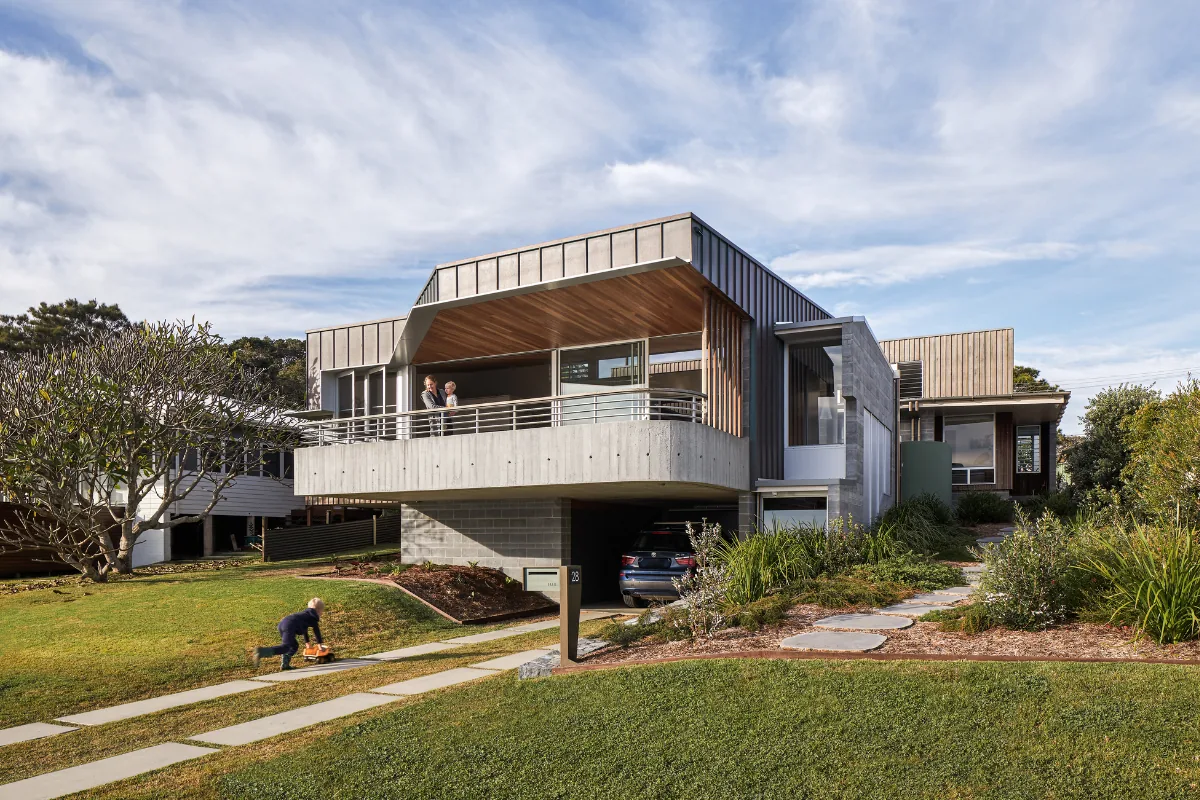
Coastal Cladding: Choosing the Right Metal for Your Corrosion Zone
Coastal cladding fails for one reason more than any other: the material was chosen for how it looks, not for where it lives. Salt air is a graded threat: a building 200 metres from breaking surf is in a different world from one 5 kilometres inland, and every cladding product has a zone where it thrives and a zone where its own warranty quietly excludes it. Here’s how the zones work, and which metal to put where.
How Australia grades coastal exposure
Atmospheric corrosivity in Australia is classified under AS 4312 on a scale from C1 to C5. C1 is a dry interior. C2 covers dry rural inland areas. C3 is the broad middle: most urban and light-industrial areas and much of the near-coastal hinterland. C4 is high-severity: calm seashore and heavy-industrial surroundings. C5 is severe marine: beachfront, breaking surf, salt spray on the glass.
The single most useful rule of thumb we give clients: within roughly a kilometre of breaking surf, standard painted steel is out of its depth. The exact boundary of each zone shifts with prevailing wind, surf energy and local topography, which is why we assess every project by its actual address, not its postcode.
Why the surf eats painted products first
Painted steel protects a vulnerable substrate with a coating. Near the surf, airborne chlorides attack that coating at every scratch, cut edge and fastener, and once salt reaches the steel, corrosion works from the inside out. That’s not a flaw. It’s the design trade-off that makes coated steel affordable, and several kilometres inland it’s a perfectly rational choice. We supply it there ourselves.
Premium metals work on the opposite principle. Copper and zinc form a living patina, a self-repairing mineral layer that is the metal’s own corrosion product, tightly bonded, re-forming wherever it’s scratched. There is no coating to fail because the protection is the metal. Aluminium sits in between: the substrate self-passivates, even at cut edges, and marine-grade coating systems such as those on Euramax aluminium add colour stability on top of a metal that was never going to rust.
The zone-by-zone shortlist
| Zone | Typical location | Comfortable choices | Specify with care |
|---|---|---|---|
| C5 severe marine | Beachfront, breaking surf | Copper · zinc · coastal-rated aluminium | Painted steel generally excluded by warranty |
| C4 high / calm shore | Sheltered waterfront, estuaries | Copper · zinc · aluminium · premium coastal steel finishes | Standard painted steel |
| C3 medium | Most urban & hinterland sites | Everything above, plus quality painted steel | · |
| C1–C2 low | Dry inland | The full range; selection is by design intent, not survival | · |
Indicative only. Zone boundaries and warranty terms always depend on the specific site and drawings. Confirm before specifying.
What each metal offers at the front row
Copper is the benchmark C5 material, genuinely at home where the closest neighbour is the Pacific. Typical service life is 80+ years, and European roofs show 150+. Its warranty is almost academic: the material’s history is the guarantee. Our Woolgoolga Beach House sits full copper on an exposed NSW headland for exactly this reason.
Zinc brings the same self-protecting patina chemistry at a friendlier price point, with a typical service life of 50+ years. Euroclad specifies VMZINC, and zinc cladding and zinc roofing remain our most-requested coastal systems on the Gold Coast. The patina never needs repainting, and pre-weathered finishes deliver the aged tone from day one.
Aluminium is the answer when the design demands a precise, unchanging colour by the sea. The substrate can’t rust, and Euramax coastal warranty tiers put a written commitment behind beachfront use; see our coastal performance deep-dive. Typical service life is 40+ years, at roughly half the weight of the alternatives.
Painted steel, Colorbond and Unicote LUX, earns its place from the mid zones inland, and coastal-grade variants extend that reach. What matters is matching the specific finish to the specific distance-from-surf, which is precisely the conversation to have before anything is ordered.
The lifecycle question nobody asks at the showroom
Over a 50-year horizon, a beachfront building can need two painted-steel re-cladding cycles in the time one copper or zinc skin simply continues weathering. When you count scaffold, labour and disruption, not just the material, the premium metal is frequently the cheaper facade, and it’s 100% recyclable with real scrap value at end of life.
Assessed on your actual address
Every Euroclad project starts with the site: distance to surf, prevailing wind, exposure, and the warranty map for each candidate material. Panels are shop-drawn in 3D and formed in-house on the Gold Coast, and we’ll tell you honestly when the humble option is the right one.
Wondering which metal is right for your site? Answer three questions and find out.
Try the Material Advisor Talk to Euroclad